
If there’s one thing I love in life… yep, you’ve guessed it. Food! I know there are those people for whom food is simply fuel. They’re the ones who eat in order to live. I, on the other hand… live to eat. I actually look forward to eating. To planning the next meal. Thinking about what I might cook. Wondering what we might have tomorrow while I’m still eating today!
But I also love feeding people. I have inherited the familiar Punjabi script: Eat some more. Just one more. You’ll have to take some home with you. You know the kind of thing. The plate is already full, your guest has clearly said, “No thank you, I really couldn’t manage another thing,” and somehow another samosa appears on the plate.
For me, there is something sacred about being together. Eating together. Sharing together. Talking together. Laughing together. But before I get ahead of myself, I invite you to take a journey with me. Listen to my story. Look through my lens, if you will. Because long before I had theological language for hospitality, I had experienced it. And long before I knew words like inclusion, belonging, justice or community cohesion, I knew what it felt like to be welcomed… and what it felt like not to be welcome.
My story
I’m a child of immigrant parents. I was born into a traditional Punjabi Sikh family.
We lived in a two-and-a-half-bedroom terraced house which we shared with two Jamaican families. Three families. One house. Each family occupied a bedroom and the rest was communal space. A tiny kitchen. Bathroom with no hot water. Outside toilet. And yet somehow, life happened.
Looking back now, perhaps some of my earliest lessons about community came from that home. Different families. Different cultures. Different food. Different accents. Shared space. We were learning how to live alongside one another in challenging circumstances, long before anyone thought to call it inclusion and belonging!
Meeting Jesus in the margins
We lived in Smethwick, in Birmingham UK. Those who know something of British social history may recognise the name and all its negative associations. In the 1964 general election campaign, Smethwick elected the Conservative MP Peter Griffiths to Parliament on the back of his racist slogan. ‘If you want a N word for a neighbour vote labour.’ This further incited racial hostility and tension which was exemplified in the activity on Marshall Street where I lived. At the time, the white residents of Marshall Street petitioned the Conservative-controlled council to purchase houses coming onto the market with the clause to let them out to white families only, with the specific intention of preventing Black and Brown families from buying homes. Thankfully the plan was ultimately frustrated by the national Labour government. So that was my street, my neighbourhood. Home.
Growing up, I also remember that we were surrounded by art. Specifically graffiti art. One particular image remains firmly in my memory. It appeared on our street walls, doors and fences in the neighbourhood. The swastika. Now, coming from Indian heritage, the swastika is an ancient religious and cultural symbol which we associate with well-being, prosperity and good fortune. It frequently appears at festivals, wedding celebrations, door posts, books, bracelets - during rakhri celebrating the special bond between brother and sister. So, you can appreciate from a child’s perspective, whenever I saw swastikas appearing around us, I thought the wider community was celebrating us and wishing us well! How delightful! Little did I realise that this particular symbol had been reappropriated and weaponised against us. What I interpreted as welcome was actually intended as intimidation and threat. Isn’t it interesting how the same image can tell a completely different story depending upon whose lens you look through?
Smethwick in those days was marked by segregation. Black and South Asian families knew of the no-go areas where they were unwelcome. Certain pubs. Certain barbers. Certain streets. Certain houses. You knew where the invisible-visible lines had been drawn.
And then, on 12 February 1965, something extraordinary happened. Malcolm X, the African American civil rights activist came to Marshall Street. He had been invited by the Asian Workers’ Union, the local anti-racist campaigners, to lend his support to the Black and Asian communities in Smethwick. Tragically nine days later, back in the United States, he was assassinated.
So you can begin to imagine something of the atmosphere in which we lived. Toxic. Threatening. Intimidating. And yet… It was also my normal. My playground. My home.
And yet… grace
Despite all of that, some good things happened! They did! You’ll be relieved to hear! There was a local church which ran a youth club every Friday. Children came from the surrounding neighbourhood. Black. Brown. White. All together. There was something powerful and quite beautiful in the gathering, a stark contrast and message to what was happening outside in the wider community.
Society was busy telling us who should live next door to whom. Who belonged. Who didn’t belong. Who was welcome. Who wasn’t. And inside that youth club? There was play, energy, fun. We could be children. We played games. We ate sweets. And while at Youth Club, we heard stories about someone called Jesus. After hearing one particular story, I remember thinking to myself: I would like to have a friend like Jesus. I was very young at the time, so I’m not entirely sure whether I thought that in Punjabi or English! Nevertheless…. the arrow prayer went up. I would like to have a friend like Jesus.
So I started to go to Sunday School. Mainly for the play, and to get out of home! Unfortunately, once my parents and our wider Sikh community realised what - and who - I was being exposed to, my church-going experience came to an abrupt end. I was accused of bringing “shame” and “dishonour” to the family by attending church. But something had already happened. A seed had been sown. And the prayer had been heard.
“Follow me”
Many years later, against all the odds, I found myself at university. The first in my extended family. Remarkable really, when you think about it. Mom was illiterate, Dad spoke very basic English, so I very much taught myself to read and write. While at university, I had a life-changing encounter - with Jesus. I said ‘yes’ to His invitation: “Follow me.” Two words. That’s all. Follow me. Those words changed everything and have remained an anchor throughout my life. Which is just as well because, although I didn’t expect following Jesus to be easy, neither did I expect the nature of some of the challenges that followed. Because suddenly I found myself navigating another culture. Church culture. And oh my goodness…
Culture shock number one: the environment
Imagine me, Punjabi, culturally Sikh, stepping into a Western church as an adult. I was completely disorientated. My mind was exploding with questions. Firstly, I couldn’t understand why people were sitting on strips of carpet placed on long wooden benches. Pews to you and me. Then I couldn’t understand why everyone was wearing coats, hats and sometimes gloves throughout the service. Indoors! It eventually became clear that someone had probably neglected to put the heating on. Then there were the shoes. Why was everybody wearing shoes in a place of worship? Coming from the gurdwara, the Sikh place of worship, this felt very strange to me. Disrespectful even. Didn’t God tell Moses to take off his sandals because he was standing on holy ground? Apparently different rules applied to church!
Culture shock number two: the language
The next shock. Language. People seemed to be speaking in code. Christianese! You see, I thought I understood English. It’s my second language, but by this point I thought I was doing reasonably well. Apparently not! Suddenly there was this whole new vocabulary I had to learn. Words. Phrases. Expressions. Assumptions. Everyone else seemed to be at ease, except me. Then there were the hymns and Bible translations which appeared to be in another language altogether. Not to mention the sound that emerged from the organ. Added to this, there was the protocol of standing up and sitting down. People stood up. Sat down. Stood up again. Sometimes, as far as I could see, without rhyme or reason. At times without rhythm either! And I was always out of synch. By the time I had worked out everyone was standing, they were getting ready to sit down again. To be honest, going to church was exhausting. There was so much to listen for. So much to look out for. So many unwritten rules. Everyone else seemed to be walking, while I was constantly running to keep up.
But the biggest culture shock was still to come.
Culture shock number three: where’s the food?
The service ended. I looked around. Something was missing. Where was the food? Where was the hospitality? Some of my first experiences of what was described as hospitality in the Western church involved a lukewarm cup of weak tea… and one dry biscuit. One. Now, I appreciate some of this might reflect the post-war British mentality of frugality. Waste not, want not and all of that. But what really fascinated me was that people seemed genuinely convinced that what they were offering, was hospitality. Now please understand. I come from a very different cultural context.
Langar
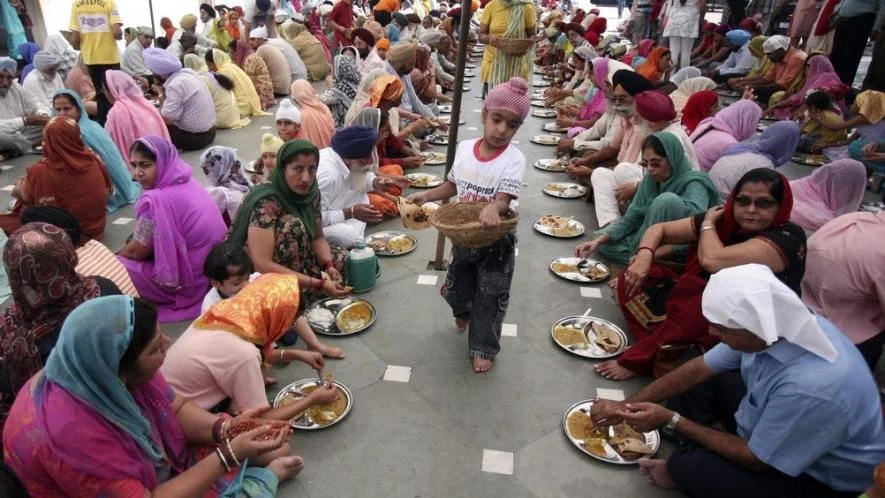
I was born into a Sikh family and grew up within the intergenerational atmosphere of the gurdwara. And at the heart of the gurdwara is the langar. The community kitchen. For those of you who have never experienced langar hospitality, let me explain. The Sikh tradition of langar developed from the earliest Sikh community associated with Guru Nanak and was deliberately shaped around equality and shared service. Food is cooked by the community and made available without discrimination; people traditionally eat together on the floor as equals, irrespective of caste, creed, religion, race or sex. Just think about that for a moment. Everybody. Rich. Poor. Male. Female. Sikh. Non-Sikh. Local. Traveller. Known. Unknown. All invited. A hot, freshly cooked, tasty vegetarian meal is served to all.
Everyone sits alongside each other, shoulder to shoulder. No head table. No special seat. No VIP area. No elevated platform for the important person. Imagine! Hierarchy is deliberately disrupted. And importantly, langar is not intended to communicate: Look how generous we are, giving something to you poor unfortunate people. No. There is something much more beautiful going on. We come together. We eat together. We share the fruit of our labour. Nobody is simply the benefactor. Nobody is merely the charity case. People serve. People receive. And eventually, those roles change. The communal kitchen is sustained through seva - service. People cook. Serve food. Pour drinks. Wash dishes. Roll out chapattis. Chop vegetables. Clean. Young. Old. Men. Women. Everyone working alongside one another. No one too important to wash up, clean the floor. Essentially serve. I love that.
“Guest is God”
Hospitality carries enormous weight in so many countries across the world, as it does in South Asian culture. There is a familiar Indian expression which is frequently used, Guest is God. Now before anyone becomes theologically anxious… No! I am not suggesting that we worship everybody who turns up at the front door! It communicates something about how seriously we receive the guest. A person enters your home and you honour them. You offer the best you have. You make room. You feed them.
My Mom used to tell stories about life in her village. Travellers or strangers might appear unexpectedly. At the house. At the well. And she would prepare food and drink for them. The conditions she lived in were basic. No shiny fitted kitchen. No five-ring hob. Mom cooked over a coal fire. Yet, regardless of facilities, you received them. You fed them. Because who knows… you could be hosting God. Sound familiar? Exactly.
Then I opened the Bible…
When I became a follower of Jesus, I loved reading Scripture. I felt as though I had come home. So many of the stories felt and sounded familiar. The families. The customs. The meals. The food. The honour. The shame. The arguments! Stories of people appearing unexpectedly at houses. Strangers being welcomed. Feet being washed. Food being prepared. Ironically, the world of the Bible often felt more culturally familiar to me than the Western church I had entered. Which was confusing. Because I would read the Bible and think: Yes! I recognise this. Then I would arrive at church… and receive the dry biscuit. I rapidly came to understand, of course, that every church has its own culture. Its own history. Its own understanding of what hospitality looks like. And sometimes… I simply had to manage my expectations and get over myself! Although I have to say, there were moments I still found peculiar. Someone would come up to me after church and explain that they had invited some people for lunch. Then they would proceed to tell me what was on the menu. Lovely, I say to myself. Wonderful. Except… they had absolutely no intention of inviting me! Let me assure you, there is no fun whatsoever in being told what is for lunch when you’re not invited!
More than food
Joking aside… there is something extraordinarily powerful about hospitality. Because it is much more than food for the stomach. Hospitality creates connection. It gives us opportunities to draw alongside people we might otherwise never meet. Differences begin to collapse. We speak. We listen. We receive. We serve. Relationships begin to change. And something happens when we sit around a table together. The labels become more difficult to maintain. Stranger. Foreigner. Outsider. Benefactor. Do-gooder. Recipient. Suddenly there is just… us and we.
Abraham notices
One of the earliest beautiful pictures of biblical hospitality appears in Genesis 18. Picture the scene… Abraham is sitting in the shade, perhaps resting like everyone else at the entrance of his tent during the heat of the day. Hot. Dry. Middle of the day. No water on tap. No air conditioning!
Then three travellers appear. What does he do? Look the other way? Pretend he hasn’t seen them? Run back into the tent and suddenly become unavailable? No. Abraham sees them… and moves towards them. That is important. Hospitality begins with noticing. He takes the initiative. He welcomes. He offers water. Rest. Food. And I just love the way the story unfolds. Abraham effectively says, Let me get you a little something to eat. A little something? Before long Sarah is baking bread, a calf is being prepared, milk and curds are appearing. This is not a dry biscuit! This is abundance. Abraham does not wait for the strangers to approach and say: “Excuse me, could we possibly trouble you for a little water?” He notices. Moves towards. Makes room. Serves. Biblical hospitality is not passive. It does not wait behind the door for the stranger to work out whether they are welcome. Hospitality takes the initiative.
Love the foreigner
And the theme continues throughout Scripture. Later, Israel is explicitly told not to mistreat the foreigner living among them but to treat the foreigner as native-born and to “love them as yourself”. Why? Because Israel itself knew what it meant to be treated as foreigners. To live somewhere that was not home. Deuteronomy describes God as the One who defends the fatherless and widow and loves the foreigner, providing food and clothing. And then God says to His people, in effect: You do the same.
Hospitality, then, is not simply something ‘nice’, people do because they enjoy entertaining. It is not reserved for the naturally sociable. It is not an optional extra for Christians who happen to own large dining tables. Hospitality is connected to justice. Memory. Identity. The character of God. Being generous-hearted in our thinking, behaviour and disposition is a divine justice imperative.
Jesus and the table
Then along comes Jesus. And again… food everywhere! Jesus invites people. Jesus gets invited. Jesus eats with respectable people. Jesus eats with people respectable society would rather avoid. Tax collectors. Men and women carrying complicated reputations. People who have been pushed outside. People who have been othered. And every time Jesus sits at a table, something seems to happen. The seating arrangements of society begin to get disrupted. Take Zacchaeus. Jesus essentially announces: “I’m coming to your house today.” Imagine! No two weeks’ notice. No chance to tidy up. Jesus eats with him. Relationship happens. Transformation follows.
Then there’s the woman in Luke 7 who enters the home of Simon the Pharisee and anoints Jesus. Simon sees that kind of woman. Jesus sees a person. And interestingly, Jesus points out Simon’s failure as host. No water for His feet. No kiss to greet. No oil. The self-same woman everybody else was judging, ends up demonstrating the very welcome the respectable host neglected to offer. That should make us think.
“I was a stranger…”
Then there is Matthew 25. Jesus says: “I was hungry…”. “I was thirsty…. “I was a stranger…”. And you welcomed me. Think about what Jesus is doing. The stranger is not peripheral to discipleship. Our treatment of those who are hungry, vulnerable, displaced or excluded becomes bound up with our response to Christ Himself. Which means the stranger cannot merely be an interruption to the mission. Sometimes the stranger is where Jesus says He can be encountered.
But hospitality goes both ways
There is another aspect of hospitality which I think we sometimes miss. Receiving. Some of us are very comfortable giving. We like helping. Organising. Serving. Providing. Being useful. But receiving? That can feel quite different. It can feel awkward. Because receiving requires vulnerability. In Luke 9 Jesus sends out His disciples with remarkably little. They have to rely upon the hospitality of others. They have to receive. Depend. Trust. They cannot arrive as the powerful ones who possess everything other people need. There’s something deeply important here. Hospitality cannot simply be: I have something. You have nothing. Let me provide for you. Because that leaves the hierarchy intact. You remain the helper. I remain the helped. You remain the giver. I remain the recipient. Biblical hospitality allows mutuality. Sometimes I serve you. Sometimes you serve me. Sometimes I bring the food. Sometimes you do. Sometimes I have the answer. Sometimes you have the wisdom I desperately need.
And… It’s okay to express a need. By the way, if that makes you feel uncomfortable, let’s remember Jesus did! Remember the Samaritan woman? Jesus asks her for water. Give me a drink. Look where that conversation led!
The Ask
We have discovered the gift of The Ask in our own neighbourhood. Some relationships have developed because we had a need, so we asked for something. Advice. Help. A tool. Nothing dramatic. Then gradually we began moving in and out of one another’s homes. Deep conversations developed. Trust was created. Food was shared.
One of our neighbours, Auntiji is a prime example of The Ask. When she cooks, she makes enough to share with others on our street. Because her neighbours are not simply people occupying houses nearby. They are friends. They are part of her wider household. Her community. That, to me, is hospitality. And just in case you’re wondering. Yes is the answer… her biryani is simply wonderful!
Even the early church struggled with the table
The early church continued to place shared meals and hospitality at the centre of community life. The New Testament repeatedly urges believers to practise hospitality towards strangers. But, and I find this strangely reassuring, they didn’t always get it right either. Read 1 Corinthians 11. The church is gathering around a shared meal and what happens? Some eat plenty. Others go hungry. Class and status begin creeping back into the room. Paul is furious. In other words, having a shared table does not automatically make us hospitable. You can have the meal… and still miss the meaning. You can use all the right theological language… and still fail to make room. Which reminds me of something.
When theology doesn’t reach the dinner table
A few years ago, I attended a conference. The speakers were eloquent, animated. Passionate. Learned. They knew the Greek. The Hebrew. The verbs. The Scriptures. They talked about radical welcome. Open heartedness. Generosity. Welcoming the stranger. They painted a wonderful picture of the Kingdom of Heaven on earth. I was inspired.
Then we went to dinner. Prepare yourselves. We had invited a friend to come with us and had informed the organisers beforehand to make appropriate arrangements. However, when we arrived, things began to unravel. Firstly, the meal was exclusive and didn’t include our friend. Secondly, no one on team offered to make room for our friend at the table. Effectively, our friend was expected to find food for themselves. So much for radical openness and welcome. It was… radically absent. Words without action are just that. Words.
Marshall Street again?
And perhaps this question matters, particularly in the times in which we are living.
There are moments when I look around and have to remind myself that I am not back on 1960’s Marshall Street.
Anti-immigrant rhetoric has become increasingly visible in public debate. Muslim communities and migrants have frequently found themselves targeted by far right movements.
I find all of this deeply unsettling. Perhaps because I have seen something of this landscape before. The language changes. The platforms change. The old symbols reappear – remember the swastika? The familiar questions return: Who belongs here?
And perhaps an equally important question for those of us who follow Jesus is: What kind of people will we become in response? Will we become frightened? Suspicious? Defensive? Will we retreat into our own groups? Or might we recover something profoundly biblical? Something wonderfully ordinary. Something potentially radical. Hospitality.
An antidote to othering
In an environment of fracture, scapegoating and suspicion, what can we do? I am increasingly convinced that hospitality is one of the quiet antidotes God has already placed in our hands. Not because a shared meal magically resolves injustice. It doesn’t. Not because masala chai and samosas can replace public policy. They can’t. But because hospitality challenges one of the basic mechanisms through which division grows: othering.
Hospitality invites us to incarnationally become those people. That community. Those immigrants. Those Muslims. Those Sikhs. Those Christians. Those foreigners. Those people who live over there.
Then you sit at a table together. You learn a name. You hear about somebody’s children. You discover what keeps them awake at night. You laugh. You disagree. You eat. You realise their biryani is much better than yours! Suddenly maintaining the category of other becomes more difficult. This is what hospitality can do. It creates the social fabric of community. It bridges divides. Challenges isolation. Builds trust. Not as a strategy. As relationship.
And this is where the langar still challenges me
I keep coming back to the langar. Everybody comes. Everybody sits together. Everybody eats together. Nobody is asked whether they are sufficiently deserving before food is placed before them. Nobody is told: “This meal is for Sikhs only.” The practice itself says something. There is room.
And I think the church can learn from that. Yes. I said it! Christians can learn something from our Sikh neighbours. Why wouldn’t we? I am not suggesting that our faiths are interchangeable. They are not. I am saying that sometimes another community can embody a practice which sends us back to our own Scriptures asking: Are we doing what we say we believe?
The Sikh tradition describes langar as communal cooking, serving, eating and sharing, intentionally practising equality and communal responsibility. Does any of that sound remotely unfamiliar to followers of Jesus? Feed people. Welcome the stranger. Serve one another. Share. Reject status. Honour dignity. Make room. Perhaps the issue is not that Scripture has failed to tell us. Perhaps we simply need to practise what we already know.
Hospitality is not a project
And while I’m here… Can we please stop turning people into projects? The refugee project. The homeless project. The asylum seeker project. The community engagement project. The diversity project. Now, of course programmes can be helpful. Organisation matters. Resources matter. But people know when they are being treated as a project. Or for diversity quotas, or an optics exercise. We know.
Jesus spent time with people. Ate with them. Asked questions. Received from them. Knew them. He did not treat them as charity cases, team performance targets, assignments or tick-box exercises. Relationship changes the dynamic. It says: I am not simply interested in what I can do for you. I am interested in you.
Hospitality will inconvenience you
However, let me warn you. Hospitality is inconvenient. Of course it is! It will disrupt things. People arrive at awkward times. They eat things you don’t eat. They eat with their hands or only a spoon. Or they don’t eat things you have lovingly spent three hours cooking! They have different needs. Different customs. Different expectations. And sometimes we only discover how attached we are to our own way of doing things only when somebody new enters the space.
For example… If someone is vegan, please do not offer them one lonely lettuce leaf while everybody else is eating a feast and then congratulate yourself for being inclusive. Prepare something feast-filled for them too! Accommodation matters. Not because people should expect everyone to rearrange the universe around them. But because making room communicates: I thought about you before you arrived. That is powerful.
Hospitality asks: What might this person need in order to participate fully? Rather than: How little do I need to change while still describing myself as welcoming? There’s a difference.
The guest may carry the gift
And here’s another thing. Sometimes we imagine hospitality is about us blessing somebody else. Look at me opening my home. Look at me serving. Look at me welcoming the stranger. Then the stranger walks through the door…. and blesses us. They bring something. A story. Wisdom. Perspective. Culture. Experience. Friendship. Food! The guest changes the host. Which is why receiving hospitality matters as much as offering it. If I always imagine myself to be the giver, I may never discover what God has placed in you. Sometimes the person we thought had arrived empty-handed…. is actually carrying the gift., the blessing.
So what does hospitality look like?
I remind myself that when I offer hospitality, I am called to represent something of the character of God. People who feel like outsiders will judge the warmth of our hospitality not by what we intended but by what they actually experienced.
Did they feel welcome? Did they feel noticed? Did they feel as though somebody was pleased they had come? Did they feel like they belonged? I remind myself that Jesus treated people as people. Not projects. I remind myself to accommodate difference. To be prepared for discomfort. To learn from cultures other than my own. And importantly… to receive. Because hospitality is not simply food. It is a posture. Openness. Generosity. Readiness. Attention. Justice. Welcome. Mutuality. It is moving towards rather than stepping away. It is noticing the person at the edges of the room. It is asking who always serves but is never served. Who speaks but is never heard. Who arrives but is never really included. Who is tolerated but never quite welcomed.
One final question
Having travelled all the way from Marshall Street…. through the church youth club… university… the terrifying organ… weak tea… one dry biscuit… the langar… Abraham’s tent… Jesus’ tables…. the early church… and back into our own neighbourhoods… I find myself returning to one very simple question. And perhaps it is the question I want to leave with you.
Not: Do I think I am a hospitable person? That is too easy. Most of us would probably answer yes!
Instead: Who is missing from my table? Who never receives an invitation? Who would feel uncomfortable entering my church? Who is always expected to adapt to us? Whose accent do we find difficult? Whose culture do we quietly regard as inconvenient? Who do I enjoy serving but struggle to receive from? Who have I reduced to a category? Who is standing on the edge while I am enthusiastically talking about inclusion? Who needs me to move my chair? Who needs food prepared for them? Who needs somebody to notice? And perhaps most challenging of all…. Who might God be asking me to receive not as a project…. not as a charity case…. not as somebody I need to fix…. but as a neighbour?
Because in a world where people are being encouraged to fear one another, hospitality makes another declaration. It says: I will move towards you. I will make room. I will listen. I am prepared to receive as well as give. You do not need to become me before I welcome you. Perhaps one of the most radical things we can still do is also one of the simplest. Open the door. Move the chair. Pass the food.
And say… You are welcome. Come. Sit. There’s room for you here.
Sikh Gudurawa Langhar
